

An engineering team builds an AI agent to handle order fulfillment. It works in testing. Then it goes to production, and on run forty-seven, it skips a verification step nobody told it to skip. Nothing in the code changed. The model just reasoned its way to a different path that day.
That's the core problem with enterprise AI automation today. An agent left to decide its own next step, across a multi-stage process like claims triage, release approvals, or order fulfillment, can wander, repeat steps, or take a path nobody approved. For engineering teams trying to ship agents that hold up in production, that unpredictability isn't a minor bug. It's the reason a working demo never makes it past a pilot.
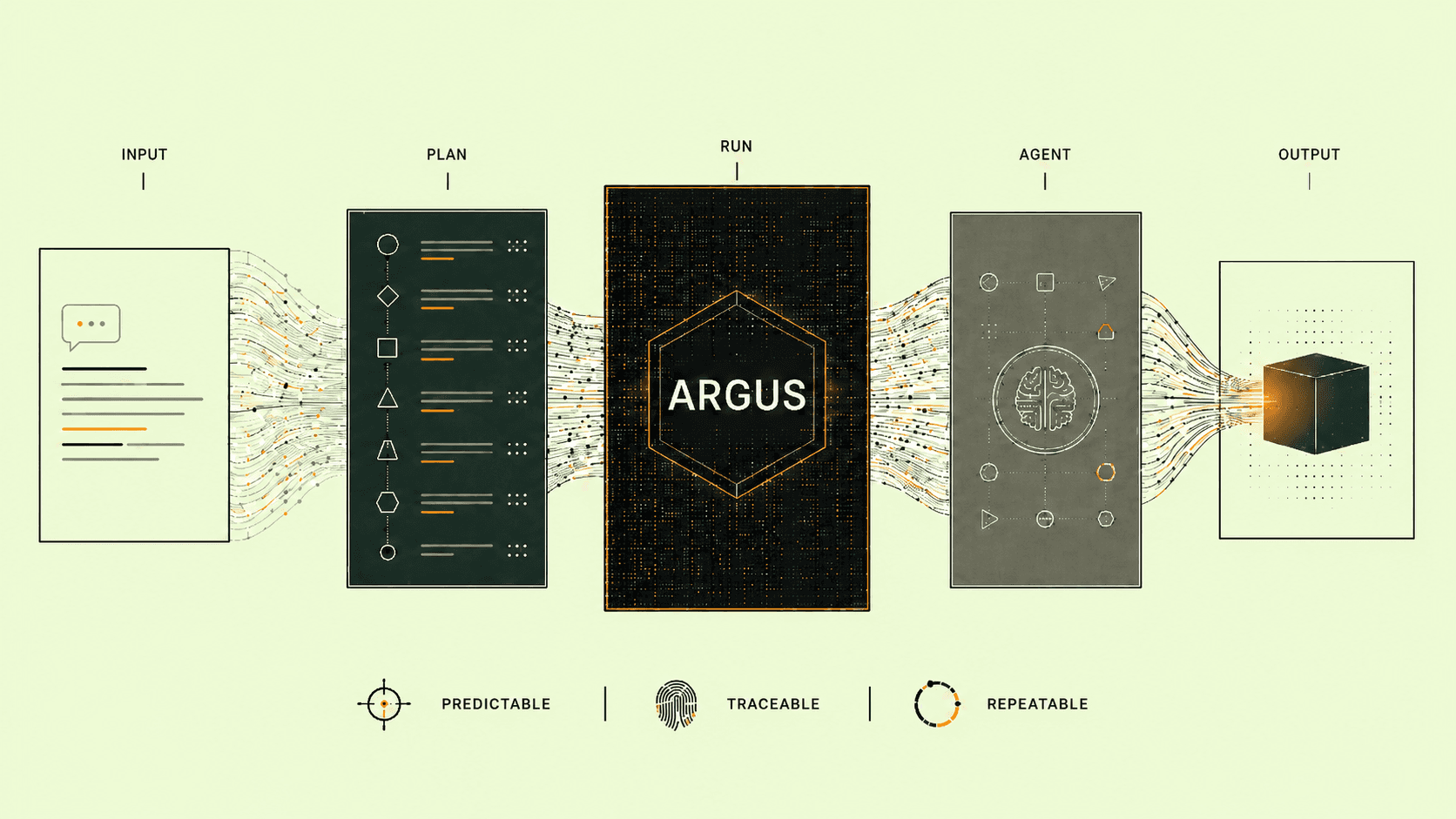
BotCircuits built Argus to fix that. Argus pairs any AI agent, including Claude, GPT, or other LLM-based agents, with a layer that controls the flow, tracks where the process stands, and records every decision along the way. The result is enterprise AI automation that runs the same way every time, no matter how many times it runs. This article covers what Argus does, why it matters, and how to get started.
Key Findings
Argus separates what the agent decides from what the process controls, so runs stay consistent
Internal tests showed up to 80x fewer tokens and 14x lower cost compared to a free-running agent
You can build a workflow by chatting with an AI, using a visual editor, or writing it directly
Every step and decision is logged, so you can see exactly what happened and why
Workflows can be paused, resumed, and reused across projects
What Is Enterprise AI Automation?
Enterprise AI automation is the use of AI agents to handle repetitive, multi-step business processes, like order processing, document checks, approvals, and routing, that used to require either manual effort or rigid scripted tools. An AI agent can read messy, unstructured input and make judgment calls a script can't. The catch is making sure that judgment stays inside a path your team actually approved, instead of drifting from run to run.
Argus is BotCircuits' answer to that catch. It sits between your AI agent and the task at hand, controls the sequence of steps, and only calls on the agent when a step genuinely needs intelligence.
Why AI Agents Go Off-Script
Business processes are repetitive on purpose. The same intake, check, and routing logic runs hundreds or thousands of times a day, and it needs to come out the same way each time. When that logic is left entirely to an AI model's judgment, small differences in reasoning produce different outcomes for the same input. One run might skip a step. Another might double back. That's hard to audit, and even harder to trust once it's running at volume.
Argus addresses this by making the process itself, not the agent, the source of truth. Your team defines the steps and the decision points once. After that, the engine runs that exact logic every time. The AI agent only gets called in for the parts that actually need judgment, like reading a document or figuring out an unclear value. Routing, retries, and pausing are handled by the engine, not left to the model to interpret.
This mirrors a point McKinsey has made about scaling AI inside real operations: the value comes from building AI into a process your team controls, not from letting a model improvise across the whole thing.
How Argus Keeps Agents on Track
Think of Argus as two things working together: an engine that knows what step comes next, and a memory that tracks everything that's already happened. Because the engine owns the navigation, the agent never has to guess.
At each step, the engine can call your AI agent to do something specific, like extract a value from a document. Anything that's a yes/no decision, like "is this order in stock" or "was this release approved," runs as a plain rule rather than something the model has to interpret on the fly. If the engine can already work out an answer from what it already knows, it does that itself and skips bothering the agent altogether.
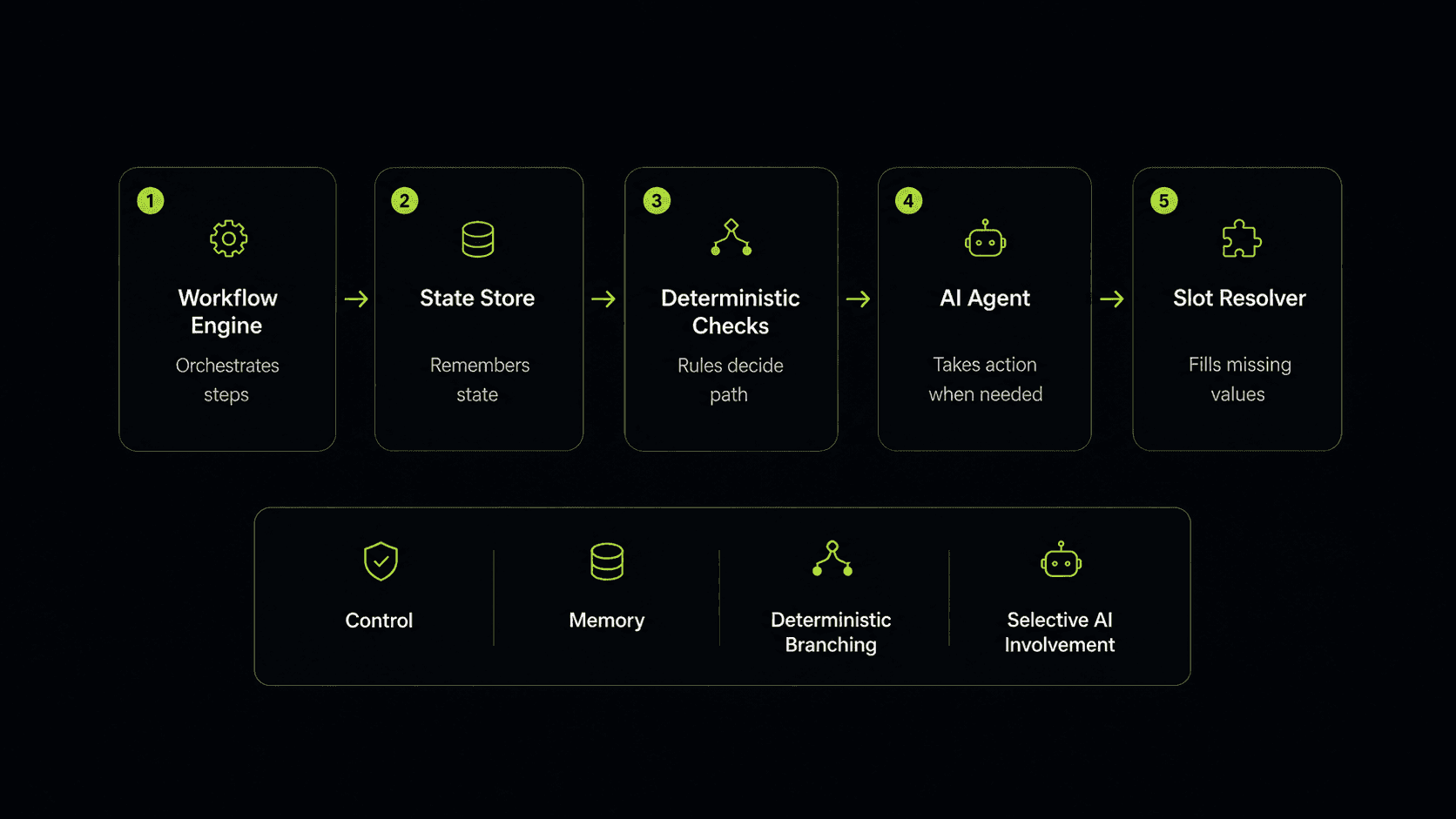
This same setup is what makes a workflow easy to pause and pick back up later. Because the engine keeps track of where things stand, rather than relying on the agent's memory, a process can pause halfway through and resume later from exactly where it left off. Nothing needs to be re-explained to the agent, and no completed step gets re-run by mistake.
Benefits of Enterprise AI Automation with Argus
For an engineering team deciding whether to build this kind of structure into their agents, the payoff comes down to four things:
Predictability. The same process takes the same path every time, so you can trust the output without re-checking every run.
Lower cost. Because routing and decisions are handled outside the model, far fewer AI calls are needed to finish the same task.
Full visibility. Every step, decision, and token used is logged, so you can show exactly how an outcome was reached, not just flag the runs that look wrong.
Less rework. Workflows are saved as reusable files, so a process built for one team can be reused as-is somewhere else, without rebuilding it from scratch.
That combination is what separates a working demo from something a team can actually run unattended in production.
Argus by the Numbers
Internal tests compared the same AI agent running freely against the same agent driving an Argus-built workflow, across tasks like shipment tracking and release approvals. The model was identical in both cases. The only thing that changed was whether the engine or the model controlled the flow.
Metric | Free-running agent | Agent + Argus | Advantage |
Mean accuracy | 100% | 100% | = |
Mean consistency | 1.00 | 1.00 | = |
Total tokens (sum) | 431,876 | 11,503 | 38× fewer |
Total cost (sum) | $1.1996 | $0.8602 | 1.4× cheaper |
Total latency (sum) | 260.8s | 182.1s | 1.4× faster |
These numbers already account for the time it takes to set the workflow up in the first place. That setup is a one-time cost, and it pays for itself across every later run of the same process. Even counting the full setup cost against a single run, the Argus path still used far fewer tokens than letting the agent handle everything itself.
The pattern held across every task tested, not just one. That consistency, not a one-off win, is what makes this a dependable foundation for enterprise AI automation rather than a clever trick that only works once.
Getting Started with Argus
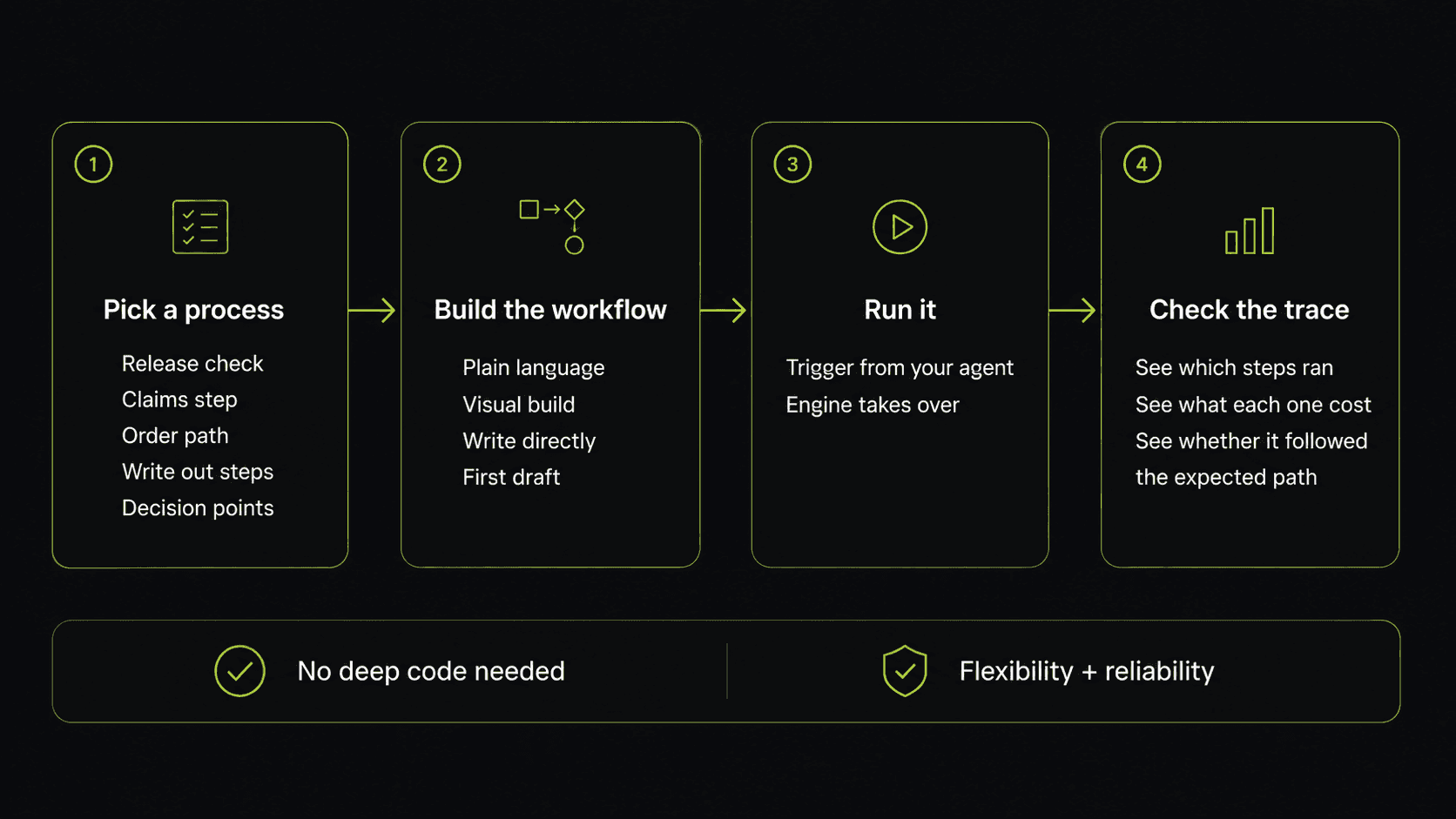
You don't need to be deep in code to build your first Argus workflow, and you don't need to throw out flexibility to get reliability.
Pick a process. Choose something repetitive, like a release check, a claims step, or an order path, and write out its steps and decision points.
Build the workflow. Describe it in plain language and let it generate a first draft, build it visually if you'd rather see the steps laid out, or write it directly if your team wants precise control.
Run it. Trigger it from your agent and let the engine take over from there.
Check the trace. Open the run afterward to see exactly which steps ran, what each one cost, and whether it followed the path you expected.
A 2024 Deloitte analysis of AI in operations work made a similar point: trust in an automated process depends on being able to explain exactly what happened at every step, not just spot-checking the runs that get flagged.
How BotCircuits Helps Enterprises Scale AI Automation
BotCircuits built Argus to remove a false choice that engineering teams keep running into: agent flexibility or process control, but not both. Argus is built so the agent contributes intelligence exactly where it's needed, while the engine keeps every run on a path your team can see and trust.
This fits naturally into high-volume operational work in any industry, from order processing and release gates to document checks and approval routing. Workflows you build with Argus run on top of the same Agent Builder your team already uses, with the same observability tooling to inspect every run. You can explore the full platform at botcircuits.ai.
Conclusion
Reliable enterprise AI automation doesn't come from a smarter model. It comes from giving that model a process it can't wander outside of. Argus delivers that by keeping the agent's judgment narrow and intentional, while the engine handles everything that needs to happen the same way every time. Research published in HBR has made a related point: customer-facing AI applications tend to be messy and unforgiving of mistakes, while back-end operations are a much better fit for agentic AI. That's exactly the gap Argus closes, giving engineering teams a way to run AI agents in production without losing sleep over what they might do differently next time.
Ready to Try Argus?
Argus gives engineering teams a dependable, visible way to run AI agents in production, without losing track of how each run actually went.
→ Try Argus: https://github.com/botcircuits-ai/botcircuits-argus
→ Learn more: botcircuits.ai
Explore BotCircuits
Platform overview: https://botcircuits.ai/product/product-overview
Agent Builder: botcircuits.ai/product/agent-builder
Voice Agent: botcircuits.ai/product/ai-voice-agent
Knowledge Base: botcircuits.ai/product/ai-knowledge-base
Observability: botcircuits.ai/product/ai-agent-observability
Our story: botcircuits.ai/about-us
See what AI agents can do for your customer operations. Book a demo
Have a question? Get in touch. Contact us
Frequently Asked Questions
What is enterprise AI automation?
Enterprise AI automation is the use of AI agents to handle repetitive, multi-step business processes, such as approvals, document checks, and routing, while keeping the outcome predictable. Argus adds a control layer so the agent's judgment stays inside an approved, repeatable path.
How does Argus make AI agents more reliable?
Argus separates the process logic from the agent's reasoning. The engine, not the model, decides what happens next and how decisions get made, so the same process follows the same path every time it runs.
How is this different from just letting an AI agent run on its own?
A free-running agent reasons through every decision itself, which can produce different results from one run to the next. Argus defines the process upfront, so the agent only gets called in for the specific steps that actually need its judgment.
Can I build an Argus workflow without writing code?
Yes. You can describe the process in plain language and have it generate a first draft, or build it visually using the flow editor. Teams that want precise control can also write the workflow directly.
How does Argus lower AI costs?
Because the engine handles routing and decisions on its own instead of asking the agent to reason through each one, far fewer AI calls are needed to complete the same process. Internal tests showed up to 80x fewer tokens used compared to a free-running agent doing the same task.
What happens if a process needs to pause partway through?
Because Argus keeps track of where a process stands outside the agent itself, a workflow can pause and pick back up later from the exact point it left off, without restarting or re-explaining anything to the agent.
Can the same workflow be reused across different teams or projects?
Yes. Workflows are saved as reusable files, so a process built once can be reused as-is in other parts of the business that need the same logic, without rebuilding it from scratch.